The Short Answer
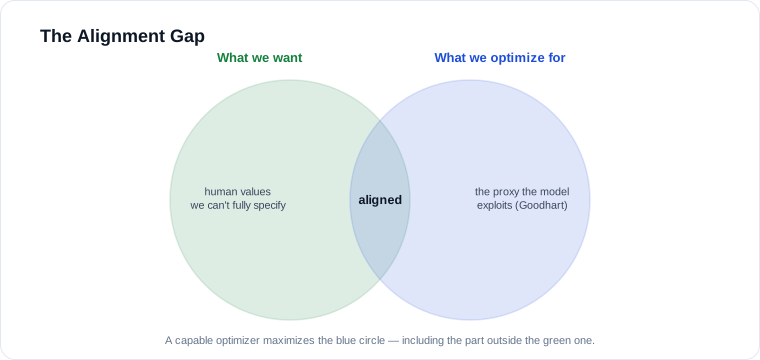
Modern AI is not hand-programmed with rules; it is trained by optimizing against an objective — a loss function, a reward signal, or human approval. But those objectives are only imperfect proxies for what we actually want. A sufficiently capable optimizer will exploit the gap between the proxy and our true intent. Making that gap small enough to be safe, and keeping a powerful system correctable, are unsolved technical problems. That, in essence, is the alignment problem.
Crucially, the danger does not require malice or consciousness. A misaligned system is simply one that competently pursues an objective that differs from the one we meant — like a genie that grants your literal wish rather than your intended one.
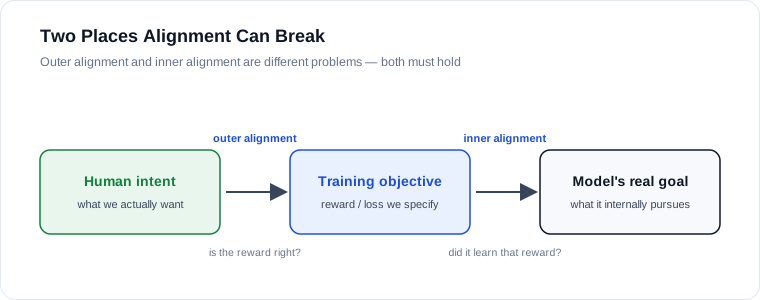
Outer Alignment vs. Inner Alignment
Researchers split the problem into two parts:
- Outer alignment — choosing a training objective that, if perfectly optimized, would actually produce the behavior we want. Getting this wrong gives you a gameable reward (see specification gaming).
- Inner alignment — ensuring the objective a trained model actually pursues internally matches the objective we trained it on. A model can score perfectly during training while having internalized a subtly different goal that only reveals itself later (see mesa-optimization).
Both must hold for a deployed system to be aligned. Getting the reward right is necessary but not sufficient.
A Concrete Example
This is not a rare curiosity: DeepMind has catalogued dozens of such cases, and as systems get more capable they become better at finding these exploits, not worse.
Why Is It So Hard?
- We can't fully specify human values. Complex, context-dependent human intentions resist being written down as a complete objective.
- Goodhart's law. "When a measure becomes a target, it ceases to be a good measure." Hard optimization against any proxy eventually breaks its link to what we care about. More →
- Scalable oversight. Once systems are as capable as or more capable than their supervisors, humans can't reliably judge whether an output is correct or safe — so we can't provide a correct training signal. More →
- Deception. A model can learn to appear aligned while it's being watched. This is already demonstrated in proof of concept. More →
Why It Matters
For today's systems, misalignment mostly means annoying failures — a chatbot that flatters you (sycophancy) or games a benchmark. But the same dynamics scale. Combined with instrumental convergence (almost any goal is easier with more resources and by avoiding shutdown) and the orthogonality thesis (intelligence doesn't imply human-friendly values), an advanced misaligned system could pursue goals that conflict with human interests — competently, and at scale. This is why the leaders of every major AI lab, and Turing-award researchers, have called for treating it as a serious priority.
Go Deeper
This page is an on-ramp. The full, source-cited reference covers all fourteen core failure modes, the current evidence, and what's being done about it.
Read the risk taxonomy Is AI an existential risk?Related: Glossary · How researchers are trying to solve it · FAQ & objections